
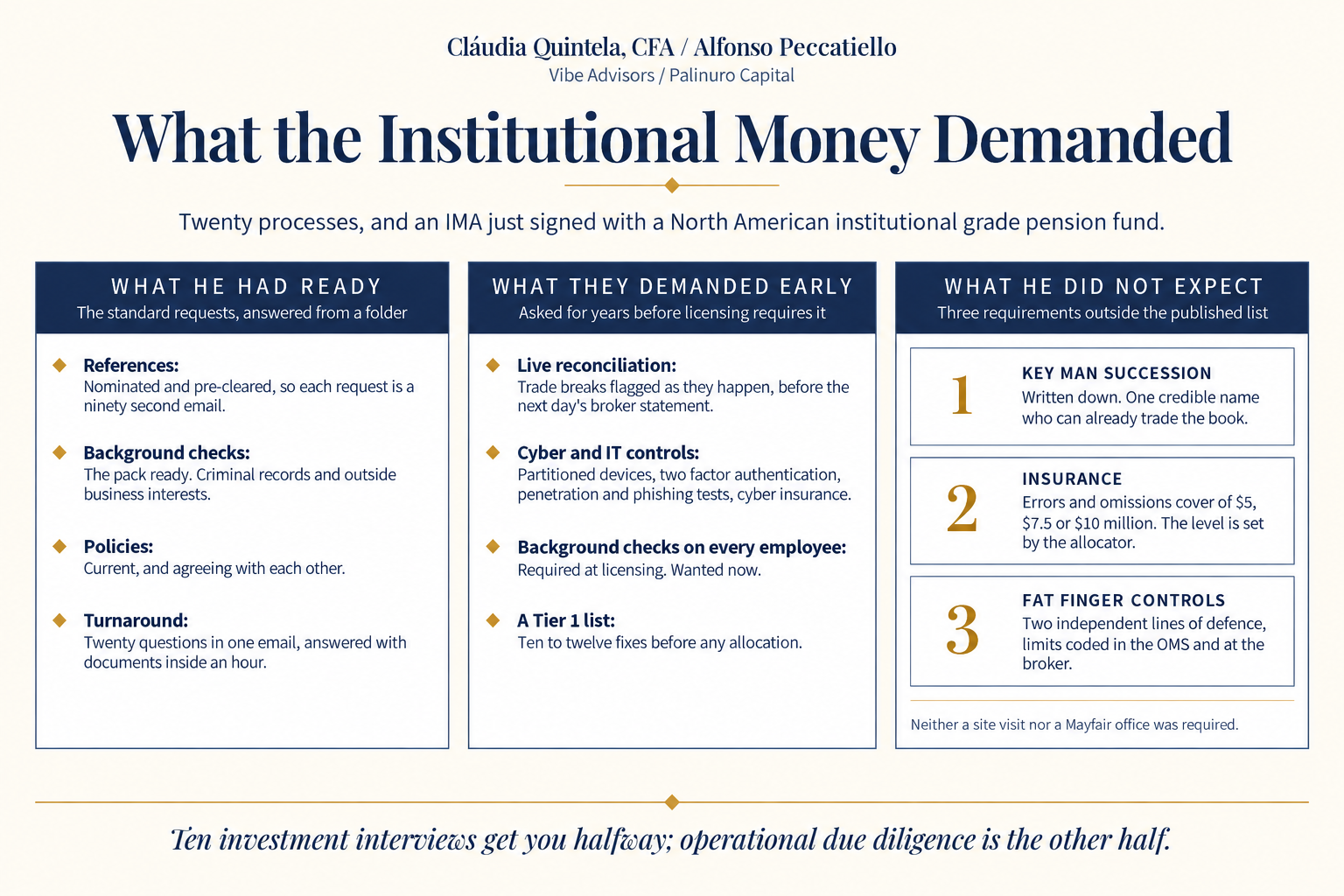
In short: An emerging manager who has just signed an investment management agreement with a North American pension fund, twenty operational due diligence processes in, on what the large allocators actually pushed on. Live trade reconciliation rather than a next-morning Excel check. A written key man succession plan naming someone who can already trade the book. Errors and omissions cover sized to the mistake the strategy can make, sometimes $10 million. Fat finger limits enforced independently in both the OMS and at the broker. What turned out to be theatre: the Mayfair office, the onsite visit, and the risk management grilling. Tier 1 findings are fix-or-no-allocation. Turnaround time is itself a diligence test, and the standard being set is twenty questions answered with documents attached inside an hour.
Alfonso Peccatiello has just signed an investment management agreement with a North American institutional grade pension fund. Twenty due diligence processes in, here is what the large allocators actually pushed on, what they ignored, and what it cost to get through.
Alfonso signed the IMA a few days ago. The money is from a North American institutional grade pension fund, it goes into a managed account, and he expects to be trading it inside a fortnight.
Most of what gets written about operational due diligence is written by people who sell operational due diligence services, or by allocators describing what they would like to see. This is an emerging manager who has just come out the other side, with the money committed, saying what the process actually demanded of him.
He has been through roughly twenty of these now. So this is the common denominator across twenty processes, from a manager who was small enough eighteen months ago to be nobody’s priority.
In his own words:
“It’s also not referring to a single DD process, anyway. It’s much more of a broad, I’ve done 20 of these by now. This is the common denominators that I’m extracting from what investors do care about a lot and what they don’t.”
I have never read an article where a manager is so open and honest about the institutional DD process. So I’d like to thank Alf for his time and generosity as this will help so many managers see and prepare for what’s to come. And it will also highlight the other side of the experience for institutional investors to see.
So here are the lessons

Claudia Quintela and Alf Peccatiello, Friday 2 October at 1pm UK, on Zoom. Pre-registration is required and places are limited.
The first big cheque is a signal to everyone else
The part he did not expect was what happened after.
“The press has picked this up. I sent a letter around, so you have seen the announcement, the press has seen the announcement. Then they come to me for comments, and all I can comment is no comment, because I don’t have anything to add rather than the formal statement allowed under the NDA. But then they still publish an article, and funnily enough, you have a bunch of follow-ups from very large institutions that are in the distribution list, and apparently they were waiting for the first large allocator to move to piggyback.”
The reasoning those institutions gave him:
“Most of them are coming and saying, look, if you’ve got money from somebody of this caliber, then most likely your ODD is okay. If you’re going to probably pass ODD, we’re not wasting our time. And if they came in and they got capacity and all of that, then we want to be with them in the founder share class pool. And then it kind of accelerates a lot of discussions, which is very nice.”
Two key arguments in that:
- The first is that a large allocator’s diligence is treated by other large allocators as a completed piece of work they no longer have to pay for. Your ODD becomes a public good the moment somebody credible has done it.
- The second is that the follow-on interest arrives wanting founder share class terms, which means the cheapest capital in your fund’s life, is the capital that shows up because somebody else went first.
I have written before about day two capital. The day you become fully investable, you become investable to everyone at once. Alfonso’s version is blunter. He calls it the snowball.
Founders are not operations people
“When you start a hedge fund, you’re not an operations person. And even if you hire an operations person, you probably cannot afford a full-fledged COO of some firm. So you’re probably a little bit blind about a few topics.”
That blindness has a cost. Allocators had told him about managers who refuse:
“Sometimes I do ODD on a small manager, and they are not willing to comply, because this costs $20,000, that costs $15,000, and this is just a waste of our time. And then managers get annoyed, because investors need you to be at certain standards or they can’t invest.”
Alf’s answer to that is the correct perspective:
“And for us, it’s the opposite, right? If we are not at that standard, then the business doesn’t exist. So very happily, we’re going to comply with everything.”
Some may call it pay to play, but this isn’t accurate. If you want to play in the first division you need a proper kit. Nobody is charging you to be allowed on the pitch. They are declining to play against someone in the wrong boots.
Palinuro is six people now. Alf has hired an operations person and someone to run business development and put order into the CRM and outreach. The ops hire is doing this gradually.
What you already know is coming
Before we look at these surprises, let’s cover the boring essentials because most managers fail here and it is entirely avoidable.
There is a body of requests that is completely standardised. You know the questions. You have known them for a year. There is no excuse for not having the answers sitting in a folder.
- References. Nominate them now. Get their permission now. Then every time a request comes in, you are letting someone know a call is coming rather than asking whether they will vouch for you. A ninety second email instead of a week of chasing.
- Background checks. Have the pack ready.
The checks themselves are narrower than people fear. Criminal records and outside business interests. That is broadly it.
What you expected, demanded years earlier than you expected it
Palinuro trades under a regulatory host today. A lot is outsourced to the host by definition, and allocators generally accept that model. But it doesn’t stop there.
When a large allocator comes in and looks through into reg host model and says, okay, that works for now. But at some point they may want you to graduate towards being an independent investment manager. This means they will want you to know what you will need when you apply for the license yourself and to prepare and have these things in place earlier.
The list he was handed, in his words: partitioned phone, partitioned computer, two factor authentication on everything you trade through, penetration testing, phishing tests, cybersecurity insurance, and the rest of what a regulated investment manager is expected to carry.
“Not that they will require it from you before getting your own investment manager license, but some allocators, they want to see that. I was expecting it, but I was not expecting it to have to do it so fast.”
Same for background checks on every employee. Required at licensing. Wanted now.
The reg host model gets you trading without a licence of your own. The allocator will still price you against the standard of a firm that has its own license, and will ask you to pre-build towards it while you are still small enough that every line item hurts.
Trade reconciliation, and the Excel that ends conversations
This is the one he spent most words on, and it is the one I would put to any manager reading this tonight.
“How do you do the reconciliation of your trades? When there are a lot of people that still do this in a semi-manual way, i.e. they receive the broker report, and then they look at the broker report versus what they have booked on an internal system, and often the internal system read is Excel, and they check that Excel of a list of positions they run versus the broker statement, and if they find something, then they will flag it, right? It’s a trade break, or whatever it is.”
Palinuro does not do that:
“We were already much more advanced than that, because we’re all good at coding and IT and tech in our firm. So we had already made our own fully automated reconciliation platform and trade breaks, flagging, and all of that is all automated.”
And the allocator’s reaction:
“And they really appreciated that, telling us, for example, that with a lot of managers that scale up, that’s a big red flag. They can never catch a trade break live because they don’t have the IT infra set up to do that. They haven’t coded up something that tells them in real time if the trade isn’t flowing in the right account, it is in the right trade, it is in the right direction. They will have to wait for the day after and do it manually versus the broker statement.”
“They care a lot about this stuff. Trading ops are incredibly important. Making sure you have processes in place, not just manual. The old – Oh, I checked the day tomorrow if it reflects what I think it should be in the book – doesn’t work anymore. They want much more than that.”
The word that matters is LIVE. Accuracy by close of business the following day is a different product. If your answer to “how would you know” ends with “the next morning”, you have given them a reason to stop.

The things he did not see coming
Alf had a list. The list came from the regulatory requirements of an investment manager, which are published and knowable.
“When you look at the regulatory requirements of an investment manager, you can see what’s expected from you over time. And so we had a list prepared. What did surprise me? Because they went beyond that.”
Three items went beyond it.
Key man succession
“Oh, key man risk. So, you know, it’s unacceptable that I am trading and then what if I’m sick? What if something happens to me?”. Allocators want key man succession plan properly written down.
I pushed back on the call, because there will always be key man risk in a firm built around one person’s judgement. His answer separates the two things properly:
“They want a soft succession plan. So they want to know who’s the person who’s going to take over if you die. And it needs to be in place. It needs to be credible. You can’t say, ah, my junior here who doesn’t have any clue. You need to have a strong right hand. I mean, I have it. So for me, it’s very simple to say it’s him. He takes over. He knows the strategy. He’s already, by the way, I mean, he can trade also today. So it’s pretty simple as a step, but they care a lot about it.”
And then the sentence to pin above the desk of every single-manager fund reading this:
“You can’t just go around and say, oh, it’s me. I’m a single manager. I run the show. I mean, sorry, but you’re not going to pass. You’re not going to pass an ODD from a large investor if you say I’m the only one taking risk. And there is no plan B or no credible plan B, really.”
It needs to be written down. A credible name in a document, and that name needs to be someone who can already trade the book.
Insurance
Alf assumed this was standard, a commodity. It’s not.
“No, they have different requirements. Some of them want a certain, like, errors and omission. Some of them want, different levels of insurance, depending on what type of mistake you run. And there is also the coverage of this insurance, right? It can really vary. It can be $5 million, $7.5, $10 million a year. And some of them have quite high requirements. I think it also depends on the allocator. Maybe some of them have been burnt before by insurance which was too small to repair a trade error.”
Another one was Errors and omissions cover, sized to the size of the mistake your strategy can make, against a requirement that varies by allocator and is sometimes set by an allocator who has been burnt. Add the cybersecurity cover from the licensing list and you are carrying multiple policies before you have carried a single management fee to profit.
Fat finger controls, on two independent lines
The one he had already solved, and rates as the biggest of the three:
“I think of the categories I said, the one I spent the least time on, because we were already very much on the ball, was the trading ops. And that’s big.”
What it means in practice:
“Anything from using an OMS that already applies several filters to prevent you from making fat finger mistakes, so having a max limit of futures lots you can trade, pre-agreed with your broker and coded up in your OMS. Having two lines of defense. Your OMS and then your broker on the other side, because the order can go through, but the broker can still stop it.”
“They want to make sure that you can’t trade sanctioned countries by mistake. They want to have them hard coded either by your broker. So basically, if you try to put down the trade, it’s not going to be cleared or accepted in the first place. And two lines of defense. Even in your OMS system, you shouldn’t be able to put up too large of a trade, and the broker should be able to stop it anyway. So this type of fat-finger prevention, it’s really important to them.”
Two lines of defence, independently enforced, with the limits agreed with the broker in advance and coded in both places. A single control is a preference.
What turned out to be theatre
I asked Alf what he had braced for that never arrived. And we giggled. It came down to three elements.
Mayfair office
Here it is in Alf’s own words.
“Quite a bunch of stuff. Where do I start? Office. I’ve heard a million times before that you must have a corner office in Mayfair. Absolutely not.”
“Me? I never thought of it. But I’ve heard very often from other relatively smaller managers, let’s say 100 million or down, that it’s very important to have an office in Mayfair.”
Nobody cares.
I would go further. If you are sub one hundred million and you are paying Mayfair rent to look investable, you have spent the money that was supposed to be invested in your business on a postcode that no allocator has ever cited as a reason to write a cheque.
Onsite visit
“Some of them are even able to proceed without an in-office visit. It’s another interesting thing. So some of them insist to have an on-office visit, basically due diligence, and some not. They never show up. They have never been in your office. They don’t care.”
“On-location ODD is not a must. Some people can proceed without.”
Risk management grilling
This is the counterintuitive one, and the reason it did not happen is specific to how he pitches.
Palinuro is discretionary. Risk on a discretionary macro book is usually where the ODD gets uncomfortable. It did not.
“When I pitch something, I’m extremely risk aware. So a lot of feedback I get is that I’m the least macro manager they’ve ever heard pitch a macro fund. What exactly does it mean is that generally they hear a pitch which is heavily concentrated, very opinionated, people that come in and basically tell them that they know better than the market. They’re going to concentrate risk. And for me, they hear a very different pitch. It’s all about my hit rate and my convexity and my stop losses and correlation stress tests.”
“These are not even questions. I just put them through because the risk management approach is fully quantitative on our side. So maybe the allocator, when it hears this type of quantitative risk management pitch, it doesn’t need to dig too deep into it.”
“But I have not been asked. Nobody has shown up to the office and said, OK, show me what you pitched in the deck from a risk management perspective. What is the system you run it through for this, this and that? But it’s never happened.”
“Although, of course, I can do it. No problem. We do it every day, twice a day. The fact that the whole pitch is based on a very quantitative risk management angle maybe soothed some of the discretionary-manager fear. Oh, the guy doesn’t have a stop. The guy can blow up. But I found it interesting that there has been no major digging of: do you really have this system? Can you really show me how you size a trade quantitatively? Very rarely this has happened.”
Risk management still gets diligenced. What happened here is that a pitch leading with hit rate, convexity, stop losses and correlation stress tests answered the question before anyone asked it. The grilling is what arrives when the pitch leaves the fear sitting there.
I told him those conversations normally arrive at the front of the process with systematic managers, where the assumption is that risk is inseparable from the portfolio system. A discretionary manager who pitches like a systematic one imports that assumption.
What they dig into instead
“Actually, it happens to me more often: they come to me and dig into the idea generation part. They want to know, ah, you’re a discretionary manager. Where are you getting your ideas from?”
They are assessing replicability. He agreed immediately, because it is the whole game:
“Some people have a much more instinctive way of approaching global macro, which is non-replicable. Maybe their instinct is somehow replicable and they know it better. From our perspective, of course we’re discretionary. We don’t just trade signals, but we have a bunch of frameworks that we have built. So even there, there are models in place. They will suggest to us whether to look at the Brazilian interest rates rather than the Mexican currency, for example, more closely, because a set of variables is pointing in that direction rather than the other direction. We will always then take a discretionary look at the idea before putting it in. We’re not a systematic manager. But my answer is: here are the frameworks. They’re based on the business cycle. They’re based on interest rates and terms of trade for a currency and whatever other macro framework we have.”
“And so the investor probably hears: okay, so if this model is there, it’s there today, and it’s there in three months, and in a year, and in two years, it will keep producing repeatable outcomes that these guys can evaluate whether to put in a trade or not. And so for me, the entire business has to be built about repeatability. Otherwise, what am I literally doing? Just shooting some trades this year? Maybe I get it right, maybe I get it wrong, but what tells me that I have a business?”
The important part to remember is that your track record cannot do the work on its own.
This is the passage I would print and hand to every manager who thinks a good year is a fundraise.
“Unless you have a very high sample size of trades in a year, which I don’t. I’m a very long time horizon oriented person. Every trade stays in the book for like over six months. That means your sample size of trades in a year is pretty small. We trade maybe 40, 50 new ideas every year. So imagine three years of live track record for us. It’s the equivalent of like 150 trades. 150 trades is completely irrelevant from a statistical perspective. Totally irrelevant as a track record.”
“And that’s why, for me, it’s all about the process. I always say to the investor: if you want to have statistical evidence of me having uncorrelated Sharpe of one with this macro strategy, you’re going to need 25 years to have a sample size that is statistically relevant. And that is not a way to run your diligence, waiting 25 years before investing. So at the end, we put a lot of emphasis on the process and on the repeatability of it, to give the investor comfort that they know what we’re doing, because the track record isn’t going to be able to do it. Statistically speaking, the role of luck will be too big. That’s true, by the way, for many, many hedge fund track records, unless they’re trading 3,000 times a year.”
Forty to fifty ideas a year. Six month average hold. Three years live is one hundred and fifty observations. He puts the time needed to prove a Sharpe of one at 25 years.
If that is the maths, then everything the allocator does other than look at your numbers is the only method available to them.
But what happens after ODD?
Tier one and tier two
Some allocators hand the findings over as a formal document. From my experience working in several DD with managers, allocators are going to be very collaborative in this part because they want to see managers implementing any of the changes they recommend. Alf confirms this:
“Some of them, Claudia, by the way, are very, very clear. They send you a list. This has happened two or three times. And they say, look, we have done the ODD. You have a big DDQ. You have a lot of stuff in place. Some stuff is excellent by the state of your AUM at the moment, in terms of ODD, state-of-the-art situation. Some is lacking. And therefore, here is a list of 10 to 12 points, which are Tier 1. And Tier 1 means you have to fix them or you will not get an allocation.”
“Then there is a Tier 2 list of points, which is: we would love for you to work with us over time to make sure that these things, which are not a priority, you will get the money if you don’t fix them before, but over time we’d like you to fix them and consult with us on how to fix them as you proceed towards your license.”
Ten to twelve items standing between you and the money. And he is candid about how managers take it:
“I have to say it’s a generally pretty straightforward process. The only thing that is not straightforward, I think the reactions are very dispersed. Some managers might think, what the hell, I can’t put this up, why should I waste all this time? It’s receiving such a list after having gone through such a lengthy DD. The IDD is done. They’ve grilled you for like 10 interviews, 12 interviews. They know in and out what you do. That part alone is literally 50% of the process. If the remaining 50% isn’t as good, you’re not going anywhere. If you’re not fixing those points, you’re not getting the money. We’re talking about large allocators here, like 100 million plus tickets. But it’s equally important.”
Ten to twelve investment interviews gets you halfway. Managers treat ODD as the administrative tail on a decision already made. It is half the decision.
Turnaround time is a diligence test in itself
“You see that the bigger the allocator becomes, the more requirements and the more professional the ODD is, and also the time.”
“If they ask a question, or a list of it, generally like 20 questions in one go, generally speaking, if you’re able to reply within an hour, with all the docs, it tells them, oh, okay, so these guys, this is not their first rodeo. They know already where to fish all this stuff, they have it available, they come back to me. If the CIO is not the guy replying to these emails, but you have a dedicated ops person, that also gives a completely different impression.”
Twenty questions in one email. An hour to answer with the documents attached. That is the standard being set by the managers you are competing with for the ticket.
My own version of this, which I say to managers constantly: the way you deal with the little things says a great deal about the way you deal with the big things. If a request is bespoke and you do not have it ready, that is fine, you were not supposed to have it ready. Tell them you will come back on Tuesday, then come back on Tuesday. Come back a month later and you have told them something about yourself that no reference is going to unsay. If you cannot manage that, how are you going to manage their money?
And the structural consequence, which is uncomfortable and true:
“Turnaround, having a structure in place where you have at least one dedicated ops person. I know for smaller managers, it’s a lot of lift. You don’t have the firepower to have all these people hired. It also speaks to the fact that if you have less than 50 million nowadays, it’s really hard to think about scaling a fund, because the requirements that are necessary in order to scale, these things you must have, Claudia, otherwise they’re not going to give you money.”
What your early investor is actually buying
I raised the emotional side, because this is what I see managers break on. The due diligence processes are long. You clear a hurdle, you think you are close, and another request arrives. Managers tell me they had no idea it would go on this long, with a binary outcome at the end that they cannot influence.
Alfonso’s answer reframed the entire thing:
“The reality is that the early investors writing 75, 100, even larger tickets, they are basically underwriting your business. In exchange, they’re getting good terms. Luckily, at least in my case, there is not even a discussion of GP stakes. I value very much my independency and I’m not up to selling GP stakes in my firm. To be honest, they’re not even asking for it. What they want is pretty fair terms and they want, especially, they want capacity, which is their way to have a large optionality.”
Capacity at fixed terms, for two years and often three:
“You’re literally selling call options in your business, and they’re buying call options in your business. So you sell some, you get some premium up front, that is the amount of money they throw at you and the management fees. Again, they’re underwriting your business. They are buying an option, you are selling an option.”
“And the premium in exchange is the management fees that are coming through the door. But not only that, the AUM increase, which is a very important signalling effect. And as it happened with me with the pension fund, the follow-up, the fact that the reputation, you have a mark, a large pension fund is invested in you. That unlocks so much. It’s a bit like an avalanche, a snowball, basically. The snowball effect. And that is also very valuable.”
You give away optionality. You get certainty back. It is a trade, and the premium is the fee income plus the signal.
The part managers never think about is what the buyer of that option is risking:
“When you buy a call option in markets, you can only lose your premium. For them, it’s very different. They can lose the premium and their reputation. So they buy an option in you. And if you’re the new Ray Dalio, then they get to allocate a large amount at pretty small fees, which is very nice. And they probably also get bragging rights in the investor community, which is equally important. But they’re also risking, compared to a normal call option, they’re risking reputation. That’s why the ODD process will be quite something. And there will be a list of non-negotiable things that you have to put in place. Otherwise, there is no money.”
There is career risk on the other side of the table. Every non-negotiable on that Tier 1 list is a line the allocator will have to defend internally if you blow up. It is normal that investors want to protect the thing that lets them keep writing cheques.
The economics
“Scaling a hedge fund, when you look at the math of the business. Unless you get seeded by someone or you spin off from Citadel and Millennium, fine. Then you live on another planet. It’s a different story.”
The people spinning out of the big platforms are a different conversation. They usually have their own capital sitting there anyway. Set them aside.
“But if you live on our planet, and you want to start a fund the way I started, effectively bootstrapping with funds of funds and other people that know your process and want to get you started, let’s say at 40, 50 million, which I believe being the bare minimum at which you can start a decent structured fund. And I’m not talking an Interactive Brokers account. I’m talking about having a clearing agreement with a bank, having some ISDAs in case you need them, and having a team in place. When you look at the P&L of the fund, you need to understand that you’re not going to make any money for minimum a couple of years, if you’re lucky.”
$40 to $50m is the floor for a properly structured launch. A clearing agreement with a bank, ISDAs, and a team. Two years minimum before the business pays you anything.
And then the second wave of spending, that does not appear in anyone’s launch budget:
“Then, if you’re lucky again, you get seeded, or you get early investors like these ones. They come in, but in order for them to come in, you have to pay. So you need to be willing to step up more capital on your side.”
“The investor is going to tell you, you have to do all these things for me to show up at the internal ODD committee and to present you. If you do these things, then your chances of being passed by the ODD committee is higher, but it’s not a certainty. So you go in and you invest in all these things and IT and cybersecurity and then you don’t know. You still don’t know if the money is coming through or not from their side. So emotionally speaking, that’s what you asked before, it’s a roller coaster.”
I want emerging managers to really sit with this. You write the cheque for the system, from limited cash, to qualify for an allocation that may not come. You are buying a ticket that improves your odds without guaranteeing anything, and you are buying it at the point in your firm’s life when the money is scarcest.
Very few people say that out loud.
The negotiation changed in your favour
Alfonso’s own view is that this is the most important thing in this piece.
“So the most important aspect, in my opinion, that you should try to write about is the change I’ve perceived from early this year to later this year. And the change is a function of the AUM increase in the multi-strat world, and also the change is the length of my track record.”
Early 2026. He has fourteen or fifteen months of hedge fund track. Multi-strat and pods AUM was materially smaller than it is today.
“And what happens is that they hook you with some amount of drawdown risk that they want to throw at you, which is very large. Let’s say 25 million drawdown limit. The equivalent of 500 million at 5% vol. So like a large amount of money.”
“And then the negotiation tactic I’ve seen two or three times is to start from large numbers and then to send you to a bunch of committees and to later basically lower this amount. So basically to play on the downside effectively, as if they know that they have a large sway on your business and they know that they are the strong party in the negotiation. So they basically squeeze you down and down as the deal progresses.”
“And the squeeze can happen on lower risk limits, lower fees, stricter exclusivity, a longer term in the deal. It can be so many things. But the attitude is that they start from a number, the number looks great, and then as you work through your process it becomes tighter and tighter and tighter.”
That is an anchoring strategy and the number that got you excited was never a final number.
Now the second half of the year:
“Then you go into the second half this year. My track record is longer. I’m outperforming other macro managers this year. I’ve had a very strong 12-month run, and the attitude changes very quickly. The attitude becomes: oh but we can actually pay fees. Oh but the exclusivity only works on a short list of competitors. Oh but we can accept less capacity from you than before. We don’t want half your capacity, for example. We want a bit less than that.”
And here is why it is not just about him:
“And I don’t think it’s only a function of my performance and my track record, but it’s also a function of their AUM. The AUM of multi-strats are going to the moon. Which basically means that the capital they have to deploy is getting bigger and bigger. And the ability for them to hire PMs in-house is hard. It’s very hard. The supply of PMs that are not already allocated as pods is not infinite. And the guys that are already at Millennium, they don’t have a reason why to switch to Citadel in the first place. And if they do, then there are very long garden leaves. So they basically can’t redeploy capital quick enough to match their AUM. And so if you are a manager that has capacity available, that doesn’t already have a competitor in an SMA, you are in a very attractive cohort for them to come after you as the AUM grow. So AUM grow from their side, pressure grows for them to deploy capital, you become more attractive. So I’ve seen this change, to be honest, over the last six months.”
I spoke about this when I looked at the AIMA Emerging Managers survey.
The deployment problem is structural. AUM has grown faster than the pool of hireable portfolio managers, and garden leave means even a successful hire is a year away from trading. External managers with clean capacity are the only supply that scales at the speed the AUM is scaling.
If you have capacity, a real track, and no competitor already sitting in an SMA with the same house, your negotiating position is better than it was in January. And it is always an SMA, never the fund.
How the institutional investor happened
I asked how he landed the first large institution. It’s the question every reader has.
“So there is no secret sauce. The secret sauce in this business, people tell you, is get the first large reasonable institutional allocator into your fund. Good luck with that.”
“The way I made that happen is that I cultivated the relationship with this specific investor for a year before the fund. We had a bi-weekly call. So he was already doing due diligence on me, before I even launched the fund. And he found me through research. So I have this research superpower, that really turbocharges relationships for me. And he found me there. I told him I wanted to launch a fund. And he’s a hedge fund investor. So we started talking about various things. And then he became a client of the research. And then over time he decided he wanted to look into the fund closer and closer. So basically, I’ve had this relationship for three years before he even decided to invest.”
Then the part that emerging managers refuse to listen to:
“I don’t know, otherwise, how can you pull in a large allocator quickly? Of course, with performance you can, but I would recommend people to really work on these relationships. If you pull up a 12-month return of 15% with a Sharpe of 2 or whatever, it’s not going to be enough unless you’ve already built the relationship for a year before with a bunch of allocators that are this type of large guys that once they come in, they basically unlock the snowball. But it’s a very slow business. Slow sales cycle, a lot of relationship work. And only like this you can reach the point where perhaps there is a hope of getting the escape velocity that you need to scale up.”
Fifteen per cent with a Sharpe of two, on its own, is not enough. Which should worry anyone currently telling themselves that a good year fixes their fundraising.
His research is how the relationship that eventually anchored the fund began, three years before there was a fund to anchor.
Luck, and the equation
I asked whether he thought it was luck, or whether there were things he did that multiplied his surface area.
“At the end, if you look at the possibility of hitting the first large ticket that allows you to have some hope of escape velocity, the chances of this are effectively the result of an equation. It’s early luck in your P&L, and in the equation goes the size of your reach and quality of your reach.”
I disagreed on the ordering. P&L is not one input among several, it is the first filter. Without it none of the reach matters. He accepted that and took it somewhere better:
“Yes. And therefore you need to be lucky. And this is something that is extremely important for people to understand. The path dependency of this business, launching a hedge fund, is incredibly high.”
Path dependency is the right term. A bad first year costs you that year and the following one, spent proving it was noise. Sometimes people have a fantastic first nine months and then wet the bed inside the first year, and if it is big enough they will spend the next year proving themselves all over again.
Here is his own path, which is the best illustration in the piece:
“I’ve been running the same strategy for eight years before starting the hedge fund. And then we start the same strategy in hedge fund format. And the first seven months, we are down, I think, six or seven percent, something like this. I run a 10 vol strategy, so this is not crazy, it’s a shallow drawdown, but it can happen. So you have a drawdown soon, out of the gate, immediately. So you can imagine what it means. The pressure is very high because you know that people aren’t going to have a lot of patience with a new fund that goes through a drawdown. Then, the 12 months after that, we have put up 16% net in 12 months, which for my vol is a very, very, very good P&L. And so you realize how you first are unlucky, then perhaps later you’re punching a bit above your body weight. It just happens. There’s bad luck and good luck. It’s part of the process.”
Eight years of the same strategy before launch. Down six or seven per cent in the first seven months. Up sixteen per cent net over the following twelve. Same process throughout. The strategy did not change between the unlucky part and the lucky part.
“People should be aware that launching a hedge fund as a business is basically like an option. And you’re going to bleed theta. Time is going to work against you because you have expenses. Luck can work against you. And it’s very likely that the first few years, for a reason or another, maybe you don’t have the right P&L, maybe you don’t have the right reach, maybe you don’t have the right quality of reach. Many, many reasons out there for which you can fail. Namely, you can’t scale in the first few years.”
You sell options to your early investors. You are also long one yourself, and yours is bleeding time value every month you do not scale.
And it will take a long time:
“I consider myself in the lucky camp, to perhaps have reached some possibility of escape velocity at some point. But generally speaking, I would expect this to take much longer. I would expect this to take minimum three years.”
What is left, once you accept you cannot control the P&L
“A lot of people focus on the hedge fund launch and they think that all they can control is their P&L. And the reality is that unless you have a Sharpe of three, I’m sorry to announce that the P&L is going to be what the P&L is going to be.”
“What you can control is the process that leads to your investment strategy. I assume that you already have a process in place and you’re just going to put it at work when you launch. What you realize is: out of your process is just one path of P&L in that specific 12 months, and you can’t control it. It can be high, it can be low, it can be negative. You don’t know.”
Then closest thing to a to-do list in this entire conversation:
“What you can control is: have you hired the right people? Do you have the right operational setup? How are you reaching out to investors? Do you have a distribution mechanism? Do you publish research? What’s your communication style? Are you sending out letters that are like, oh look, basically I hide bad news and I only tell you good news? Are you sending letters regularly? Are you providing insights? During IDD and ODD, are you 100% honest, or are you trying to hold back? All these things you can control. You can control all of them. And they are so important in increasing the chance of success.”
I would add the behavioural layer to that, because it is the part allocators talk about privately and rarely write down.
You can control how you show up, regardless of what the market is doing to you. Whether you answer investors quickly, and whether an investor believes that if something goes wrong you will make their life easier when they have to explain it to their board, or harder.
The same goes for bad news. Imagine a proper storm in the market, a real hit to the portfolio, a drawdown. How do you communicate it? What does your handling of it tell an investor about you?
What to do now if you’re an emerging manager
None of this requires an allocator’s permission and you can do this right now:
Answer the trades ops questions. If a trade goes into the wrong account in the wrong direction at eleven this morning, when do you find out?
Write the succession down. One name, someone who can already trade the book, in a document. If you cannot name that person, you have found the thing that will stop you at the last hurdle after ten interviews.
Assemble the pack that you know is coming. References nominated and pre-cleared. Background checks done. Policies current and agreeing with each other. Then measure yourself against the standard: twenty questions in, answered with documents attached, inside an hour. The full data request, and what each section is actually testing, is the previous issue.
None of that is glamorous. It’s also cheaper than that Mayfair office.
And for the opportunity to come ask us questions LIVE, Alf and I are running a Webinar to discuss this topic on October 2nd at 1pm UK
Come and join us LIVE. This event is pre-register only and has capacity limits.
See you there.
Frequently asked questions
What does operational due diligence actually ask an emerging manager for?
Beyond the standardised requests, the items that surprised a manager twenty processes in were key man succession, insurance, and fat finger controls. Allocators also pushed hard on live trade reconciliation, and asked him to pre-build towards independent investment manager standards while still trading under a regulatory host: partitioned phone and computer, two factor authentication on everything traded through, penetration testing, phishing tests and cybersecurity insurance.
What is a key man succession plan and why do allocators insist on one?
A written document naming the person who takes over if the principal cannot trade. It has to be credible, which means the named person must already be able to trade the book, not a junior. A single manager who answers that there is no plan B will not pass an ODD from a large investor, however good the returns.
Why does live trade reconciliation matter so much in operational due diligence?
Because the word allocators care about is live. Many managers still check a broker report against an internal Excel the following morning. An allocator’s concern is that such a manager can never catch a trade break as it happens, and for scaling managers that is treated as a significant red flag. If the answer to “how would you know” ends with “the next morning”, it is a reason to stop.
What are Tier 1 and Tier 2 ODD findings?
Some allocators deliver their findings as a formal list. Tier 1 items, typically ten to twelve of them, must be fixed or there is no allocation. Tier 2 items are things the allocator would like fixed over time and will consult on, but which do not block the money. Managers often treat ODD as the administrative tail on a decision already made. It is roughly half the decision.
Do allocators require a Mayfair office or an onsite visit?
No. Both turned out to be theatre. A corner office in Mayfair was never cited as a reason to allocate, and paying that rent below one hundred million spends money that should be in the business. Some allocators insist on an onsite visit and others proceed without ever seeing the office. On-location ODD is not a must.
What insurance does an allocator expect?
Insurance is not the commodity most managers assume. Requirements vary by allocator and by the size of mistake the strategy can make. Errors and omissions cover can be required at $5 million, $7.5 million or $10 million a year, and some allocators set high requirements because they have been burnt by cover too small to repair a trade error. Cybersecurity cover sits on top of that.
How quickly should a manager respond to an ODD request?
The standard being set is twenty questions answered inside an hour with the documents attached. Turnaround time is itself a diligence test. Having a dedicated operations person answering rather than the CIO creates a different impression again. Anything bespoke can reasonably take days, but the date you give is the date you must hit.
Why does the first large allocation unlock the others?
Because other large institutions treat a credible allocator’s diligence as work they no longer have to repeat. Follow-on interest arrived from institutions that had been waiting for someone to move first, and they arrived asking for founder share class terms. The cheapest capital in a fund’s life is the capital that shows up because somebody else went first.
Key takeaways
- Live trade reconciliation is the operational line that separates managers who can scale from managers who cannot. A next-morning Excel check against the broker statement is treated as a red flag.
- A key man succession plan has to be written down and name someone who can already trade the book. “I’m the only one taking risk” fails an institutional ODD on its own.
- Eight of the areas an allocator diligences have nothing to do with how you invest. They are asking whether there is a firm here at all, and Tier 1 findings are fix-or-no-allocation.
- Turnaround time is a diligence test that runs whether you know it or not. Twenty questions, an hour, documents attached, is the standard your competitors are setting.
- The Mayfair office, the onsite visit and the risk management grilling are theatre. The money that would have paid the rent belongs in the operational infrastructure that actually gets diligenced.
Cláudia Quintela is the founder of Vibe Advisors, an independent hedge fund placement and advisory boutique helping emerging hedge fund managers raise institutional capital. 25 years across State Street, UBS, Morgan Stanley, and Blenheim Capital. MSc Finance, LSE. CFA charterholder. Based in London.
Three ways to work with me:
- A fund manager who wants to work with me on the asset-raising side? Apply here.
- Allocating to emerging managers? Get in touch.
- Want an hour on your own situation, no ongoing commitment? Book a consulting call.
This publication is provided for educational and informational purposes only. The views and opinions expressed are those of the author and do not necessarily reflect those of any third party.
Nothing contained in this publication constitutes investment, legal, tax or other professional advice, nor should it be relied upon as such. Nothing in this publication constitutes an offer, invitation, recommendation or solicitation to buy or sell any security, fund or other financial instrument, or to engage in any investment activity.